
How to Aliquot Peptide Vials

How to Aliquot Peptide Vials: A Clinical Guide to Preserving Compound Stability
In clinical research and molecular biology, the stability of a peptide compound is the single most critical factor in ensuring accurate, reproducible data. Peptides, by their very nature, are fragile structures held together by delicate amino acid bonds. Once a lyophilized (freeze-dried) peptide is reconstituted with a solvent, a ticking clock begins.
While storing reconstituted peptides in a standard laboratory refrigerator (2°C to 8°C) is sufficient for short-term use (typically 20 to 30 days), long-term storage requires freezing. However, repeatedly freezing and thawing a single master vial will rapidly degrade the peptide bonds.
The clinical solution to this problem is aliquoting.
To aliquot a peptide means to divide a single, freshly reconstituted master vial into multiple, smaller single-use or weekly-use portions. This protocol ensures that the bulk of your research compound remains perfectly preserved in a deep freeze until the exact moment it is needed. Here is the definitive guide on how to aliquot peptide vials safely and accurately.

The Science of Degradation: Why Do We Aliquot?
To understand why aliquoting is necessary, researchers must understand how peptides degrade in an aqueous solution.
- The Freeze-Thaw Shearing Effect: When water freezes, it expands and forms sharp crystalline structures. If a peptide solution is frozen, thawed, and frozen again, these ice crystals act like microscopic razor blades, physically shearing the fragile non-covalent bonds of the peptide chain. Just two or three freeze-thaw cycles can render a highly potent compound completely inactive.
- Hydrolysis and Oxidation: Once water is introduced to a lyophilized powder, the peptide begins to undergo hydrolysis (cleavage of chemical bonds by water) and oxidation (exposure to oxygen). Freezing the solution drastically slows down these kinetic reactions.
- Contamination Mitigation: Every time a needle punctures the rubber stopper of a master vial, there is a micro-risk of introducing bacterial contaminants. Aliquoting limits the master vial to a single exposure event.
By aliquoting, you ensure that any given micro-portion of your peptide undergoes exactly one freeze cycle and one thaw cycle in its lifetime.
Required Laboratory Equipment
Before breaking the seal on your lyophilized vial, ensure your sterile workspace is equipped with the following materials:
- Sterile Microcentrifuge Tubes (Eppendorf Tubes): It is critical to use low-protein-binding tubes (typically 0.5 mL or 1.5 mL sizes). Peptides are highly “sticky” and will adhere to the walls of standard, cheap plastic tubes, causing a massive loss of total yield. Low-bind tubes are specially coated to prevent this.
- Bacteriostatic Water or Sterile Solvent: To reconstitute the master vial.
- A Precision Micropipette or U-100 Insulin Syringes: For transferring the exact liquid volumes.
- Sterile Alcohol Swabs (70% Isopropyl): For sanitizing all surfaces and stoppers.
- Labeling Tape and Cryo-Markers: For identifying the contents and concentrations of each micro-tube.
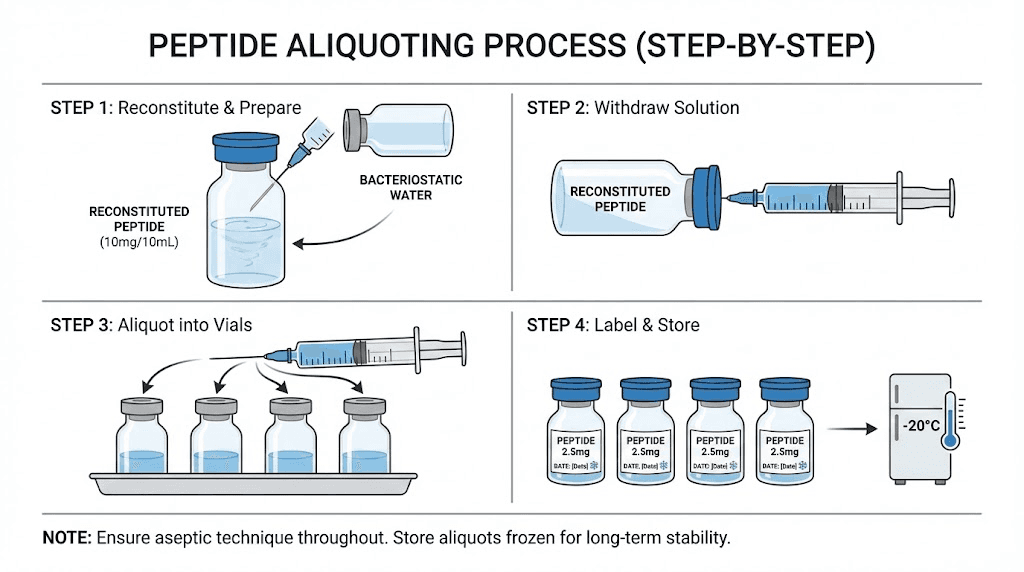
Step-by-Step Aliquoting Protocol
Step 1: Reconstitute the Master Vial
Begin by calculating your desired final concentration. Reconstitute your lyophilized peptide vial using Bacteriostatic Water. Swab the stopper, inject the water slowly down the inner glass wall, and gently swirl the vial. Do not shake it. Wait until the solution is completely clear and dissolved.
Step 2: Calculate Your Aliquot Volumes
Determine how much liquid represents a single use or a single week of research. Example: You have reconstituted a 10mg peptide vial with 2.0 mL of bacteriostatic water. You wish to create ten separate 1mg aliquots. Therefore, you must draw and transfer exactly 0.2 mL (20 units on a standard insulin syringe) into ten separate microcentrifuge tubes.
Step 3: Prepare the Micro-Tubes
Line up your sterile, low-protein-binding microcentrifuge tubes in a tube rack. Open all the lids prior to extraction to minimize the time the peptide spends exposed to ambient air and room temperature.
Step 4: The Transfer Process
Using a freshly unpackaged U-100 syringe (or a sterile micropipette with a new tip), draw the calculated volume from the master vial. Carefully deposit the liquid into the bottom of the first micro-tube. Do not let the liquid splash up the sides of the tube. Repeat this process until the master vial is empty, using a fresh syringe if you suspect the needle has become blunt or contaminated.
Step 5: Seal and Label
Close the caps of the microcentrifuge tubes tightly. Label each tube immediately with the peptide name, the total microgram/milligram content of the tube, and the date of reconstitution. Unlabeled clear liquid in a freezer is a major biohazard and research liability.
Step 6: Flash Freezing and Long-Term Storage
Immediately transfer the aliquoted tubes to a deep freezer. The ideal storage temperature for aqueous peptides is -20°C (or -80°C for ultra-long-term preservation).
Critical Warning: Do not use a “frost-free” freezer. Modern residential freezers have an auto-defrost cycle that routinely raises the internal temperature to melt frost. These hidden, daily temperature fluctuations will slowly destroy aliquoted peptides. Use a manual-defrost laboratory freezer or a standard deep-chest freezer.
Thawing an Aliquot for Use
When you are ready to use an aliquot, remove a single micro-tube from the freezer. Do not apply external heat (like a hair dryer or warm water) to speed the process. Allow the tube to thaw naturally at room temperature or in the refrigerator. Once completely thawed, the liquid can be drawn up into a syringe for immediate administration.
By mastering the aliquoting process, researchers can confidently purchase larger, more cost-effective vials of lyophilized peptides, knowing they possess the laboratory skills to preserve the chemical integrity of the compound indefinitely.
Disclaimer: This guide is for educational and laboratory research purposes only. Peptides are not intended for human consumption without strict medical supervision. Always consult with a licensed healthcare professional or principal investigator before beginning any new protocol.
