
Tirzepatide Dosage Chart and Titration Guide
Tirzepatide Dosage Chart and Titration Guide
Tirzepatide has fundamentally changed the landscape of metabolic research and weight management. As the first dual GIP and GLP-1 receptor agonist, it works synergistically on two distinct hormonal pathways to drastically reduce appetite, slow gastric emptying, and improve insulin sensitivity.
However, because of its profound potency, tirzepatide cannot be introduced to the body at its maximum strength. It requires a strict, gradual titration schedule. Rushing this process can lead to severe gastrointestinal distress, while failing to advance the dosage properly can stall metabolic progress.
Whether you are a clinical researcher studying metabolic pathways or a patient navigating a physician-directed protocol, understanding the standard dosing schedule is paramount. Here is the definitive tirzepatide dosage chart and titration guide.

The Standard Tirzepatide Dosage Chart
Tirzepatide is administered via subcutaneous injection once a week. The clinical protocol utilizes a “step-up” approach, increasing the dose in 2.5 mg increments every four weeks.
| Treatment Phase | Weekly Dose (mg) | Duration | Clinical Purpose |
|---|---|---|---|
| Initiation | 2.5 mg | Weeks 1 – 4 | Acclimate the body; minimize GI side effects. |
| Step-Up 1 | 5.0 mg | Weeks 5 – 8 | First therapeutic dose; initial weight & glycemic changes. |
| Step-Up 2 | 7.5 mg | Weeks 9 – 12 | Continued titration for enhanced metabolic response. |
| Step-Up 3 | 10.0 mg | Weeks 13 – 16 | Common maintenance dose for moderate responders. |
| Step-Up 4 | 12.5 mg | Weeks 17 – 20 | Advanced titration for those requiring higher efficacy. |
| Maximum | 15.0 mg | Week 21+ | Maximum approved dose for peak metabolic intervention. |
Why Do We Start Low? Understanding “Step-Up” Dosing
A common misconception among new researchers and patients is that the starting dose of 2.5 mg will trigger rapid weight loss. The 2.5 mg dose is not intended for profound glycemic control or weight reduction.
Its sole purpose is pharmacological initiation. GLP-1 and GIP receptors in the gastrointestinal tract are highly sensitive. Flooding them with a high dose of tirzepatide immediately will almost certainly trigger severe nausea, vomiting, diarrhea, and gastric paralysis.
By starting at 2.5 mg and waiting a full four weeks before escalating to 5.0 mg, your body builds a natural tolerance. This step-up protocol ensures that when you finally reach the highly effective maintenance doses, the side effects are minimal or entirely absent.
Finding Your Ideal Maintenance Dose
It is a common myth that everyone must eventually reach the maximum 15 mg dose. In clinical practice, the goal is always to use the lowest effective dose.
If you achieve your desired weight loss and metabolic stability at 7.5 mg or 10.0 mg weekly, there is no biological requirement to increase the dosage to 12.5 mg or 15.0 mg. Pushing the dose higher when it isn’t necessary only increases the financial cost of the protocol and raises the risk of side effects, without necessarily providing proportionate benefits.
You should only step up to the next dose bracket if your weight loss has completely stalled for several weeks, and only if you are currently experiencing zero negative side effects at your current dose.
Protocol for Missed Doses
Consistency is key to maintaining stable serum levels of tirzepatide. However, if a scheduled weekly injection is missed, follow these clinical guidelines:
- Within 4 Days (96 hours): Administer the missed dose as soon as you remember.
- Beyond 4 Days: Skip the missed dose entirely. Wait until your next regularly scheduled day to take your standard injection.
- The 72-Hour Rule: Never administer two doses of tirzepatide within 3 days (72 hours) of each other, as this can cause a rapid accumulation of the drug, leading to severe hypoglycemia and severe nausea.
Reconstituting Tirzepatide: The Math for Vials
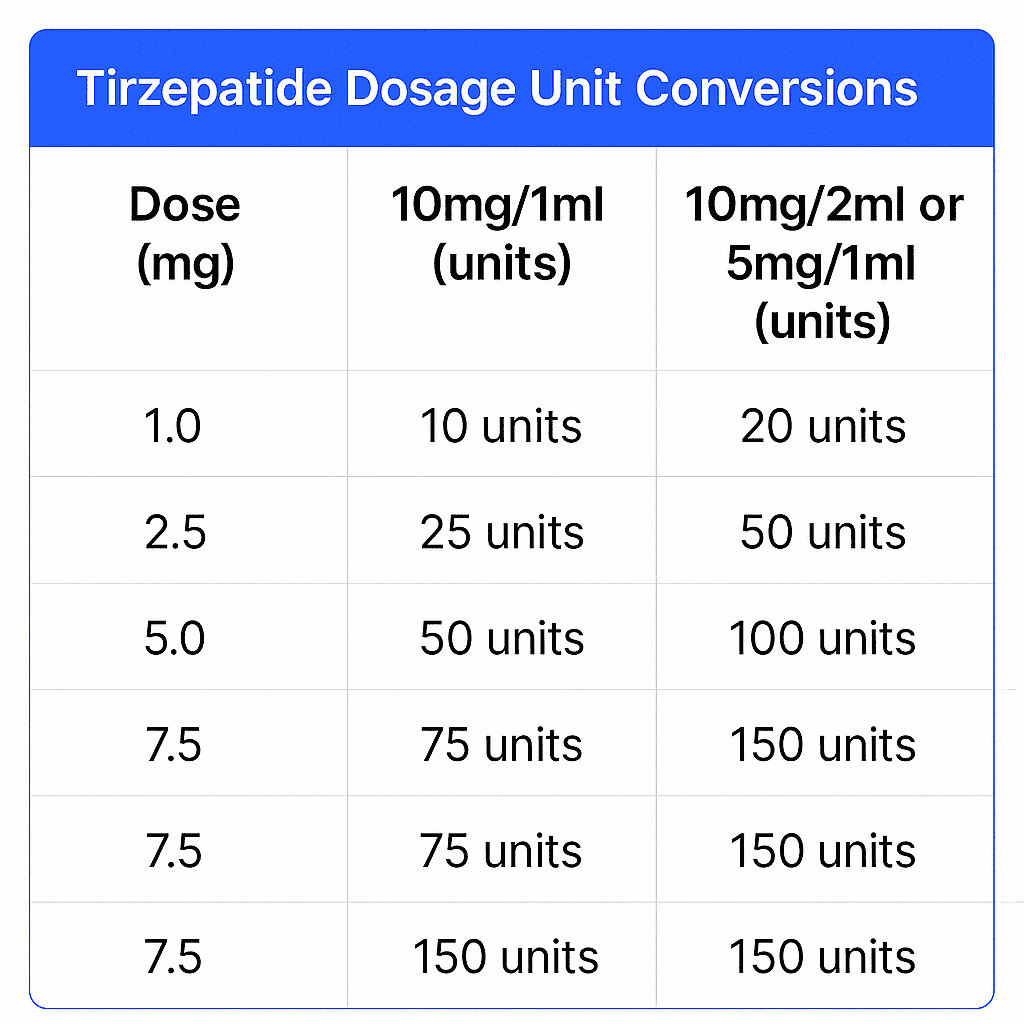
Commercial tirzepatide (like Zepbound or Mounjaro) comes in pre-filled, single-use auto-injector pens. However, if you are purchasing clinical-grade lyophilized tirzepatide for research purposes, it will arrive as a powder in a vial. You must reconstitute it with Bacteriostatic Water and extract your specific dose using a U-100 insulin syringe.
Because tirzepatide vials come in various total milligram sizes (e.g., 10mg, 15mg, 30mg), you must calculate your draw accurately.
Example: Extracting a 2.5 mg starting dose from a 15 mg vial.
- You add 1 mL of Bacteriostatic Water to your 15 mg vial.
- Your vial now has a concentration of 15 mg per 1 mL.
- To find the liquid volume for 2.5 mg, divide the target dose by the total milligrams: 2.5 ÷ 15 = 0.166 mL.
- On a standard U-100 syringe, 0.166 mL equals approximately 17 units.
If calculating these conversions manually introduces a risk of error, we highly recommend utilizing a [Peptide Dosage Calculator] to instantly find your exact syringe units before drawing your dose.
Conclusion
Tirzepatide is a remarkably powerful compound that requires a disciplined, mathematically sound approach. By strictly adhering to the four-week, 2.5 mg step-up titration schedule, you can safely navigate the body’s natural adaptation phase while mitigating uncomfortable side effects. Remember to listen to the biological feedback, stay at the lowest effective maintenance dose, and always ensure your reconstitution math is flawless.
