
Tirzepatide Dosage in Units
Tirzepatide Dosage in Units
Understanding tirzepatide dosage in units is key for anyone reconstituting this peptide for personal use, whether you’re new to peptides or have experience with reconstitution. Unlike traditional medications where dosage is labeled strictly in milligrams (mg), peptides like tirzepatide are often measured in units when drawn into an insulin syringe. This makes accurate dosage tracking critical—especially for those using tirzepatide for weight loss, metabolic regulation, or glucose control.
A “unit” refers to the hash marks on a standard U-100 insulin syringe, where 100 units equals 1ml of liquid. So, when you reconstitute a 5mg or 10mg vial of tirzepatide with bacteriostatic water, you’ll need to know how many units equal your target dose in milligrams.
This guide breaks down everything you need to convert mg to units, understand compounded tirzepatide dosage in units, and avoid common injection mistakes. Whether you’re trying to determine how many units is 2.5 mg of tirzepatide or build a long-term dosing schedule, having a clear understanding of units will help ensure accuracy, safety, and consistency in your regimen.
Let’s break it all down step-by-step to simplify your tirzepatide journey.
What Does “Dosage in Units” Mean?
When people talk about tirzepatide dosage in units, they’re referring to the amount drawn up into an insulin syringe, which measures in units rather than milligrams (mg) or micrograms (mcg). This is especially important for peptides like tirzepatide, which need to be reconstituted before use. Once you’ve added bacteriostatic water to your peptide vial, you’ll administer doses based on how many units of solution you pull into the syringe—not directly in milligrams.
So what exactly is a “unit”? On a standard U-100 insulin syringe, 100 units equals 1ml of liquid. That means every 10 units is 0.1ml, 50 units is 0.5ml, and so on. The conversion from units to mg depends entirely on how you mix your tirzepatide.
Let’s use an example:
You have a 10mg vial of tirzepatide, and you add 1ml of bacteriostatic water. This means you now have a solution where every 10 units = 1mg. So if your goal is to inject 2.5mg of tirzepatide, you would draw up 25 units on your syringe. That’s 0.25ml of your total solution.
If you reconstitute the same 10mg vial with 2ml of BAC water, your concentration is now 5mg per ml. In this case, 10 units = 0.5mg, and 50 units = 2.5mg. It’s the same peptide, but a different dilution ratio—so the number of units needed for the same dose will change.
This is why tirzepatide dosage in units can’t be standardized without knowing the dilution. It’s also why using a peptide dosage calculator is highly recommended. It helps ensure you’re injecting the right amount based on your vial concentration and how much BAC water you used.
Understanding this relationship between mg, units, and dilution is critical. Whether you’re microdosing or working up to a higher tirzepatide dosage, knowing how to convert your dose into syringe units will make your experience safer and more consistent.
Common Tirzepatide Mixing Ratios and Unit Conversions
When using tirzepatide, one of the most important steps is knowing how to mix it correctly—and how that mix translates to accurate syringe dosing. Whether you’re working with a 5mg or 10mg vial, the amount of bacteriostatic water (BAC water) you add will determine your mg-to-units conversion.
Let’s start with the two most common reconstitution ratios:
1. 10mg Tirzepatide + 1ml BAC Water
You get a concentration of 10mg/ml, or 1mg per 10 units on a U-100 insulin syringe.
This means:
2.5mg = 25 units
5mg = 50 units
7.5mg = 75 units
2. 10mg Tirzepatide + 2ml BAC Water
This yields 5mg/ml, or 0.5mg per 10 units.
You would then need:
2.5mg = 50 units
5mg = 100 units
7.5mg = 150 units
Now let’s say you’re using a 5mg vial of tirzepatide and add 1ml BAC water—a popular setup for compounded tirzepatide dosage in units. Your solution is now 5mg/ml, which translates to 0.5mg per 10 units. To take 2.5mg, you’ll draw 50 units. This is one of the most common doses users start with.
Here’s a quick reference chart:
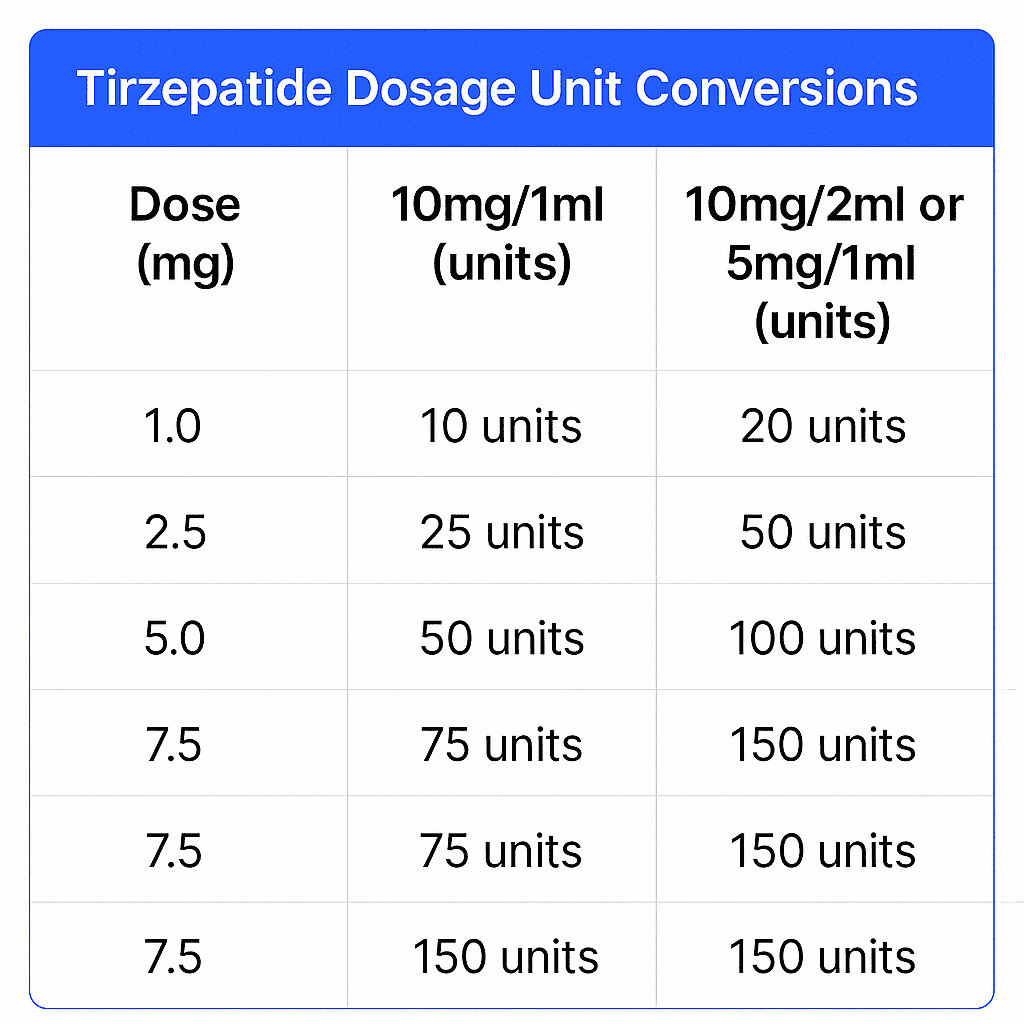
Accurate mixing and measuring is critical to avoid under- or overdosing. Always double-check your concentration and use a reliable tirzepatide dosage calculator to confirm the right draw amount for your syringe.
Tirzepatide Dosage Chart in Units (Beginner + Advanced)
Understanding your tirzepatide dosage chart in units is essential for achieving accurate and consistent dosing. Whether you’re using a 5mg or 10mg vial, the number of syringe units you draw will vary depending on how much bacteriostatic (BAC) water you’ve added. This section breaks down both beginner and advanced dosing protocols using insulin syringes marked in units.
Reconstitution Recap
Let’s assume two of the most common mixing ratios:
5mg Tirzepatide + 1ml BAC water = 0.05mg (50mcg) per unit
10mg Tirzepatide + 2ml BAC water = 0.05mg (50mcg) per unit
In both cases, each unit on a 1ml (100-unit) insulin syringe equals 50mcg. This makes unit-based dosing flexible and precise for users of tirzepatide compound dosage in units.
Beginner Tirzepatide Dosage Chart (Units-Based)
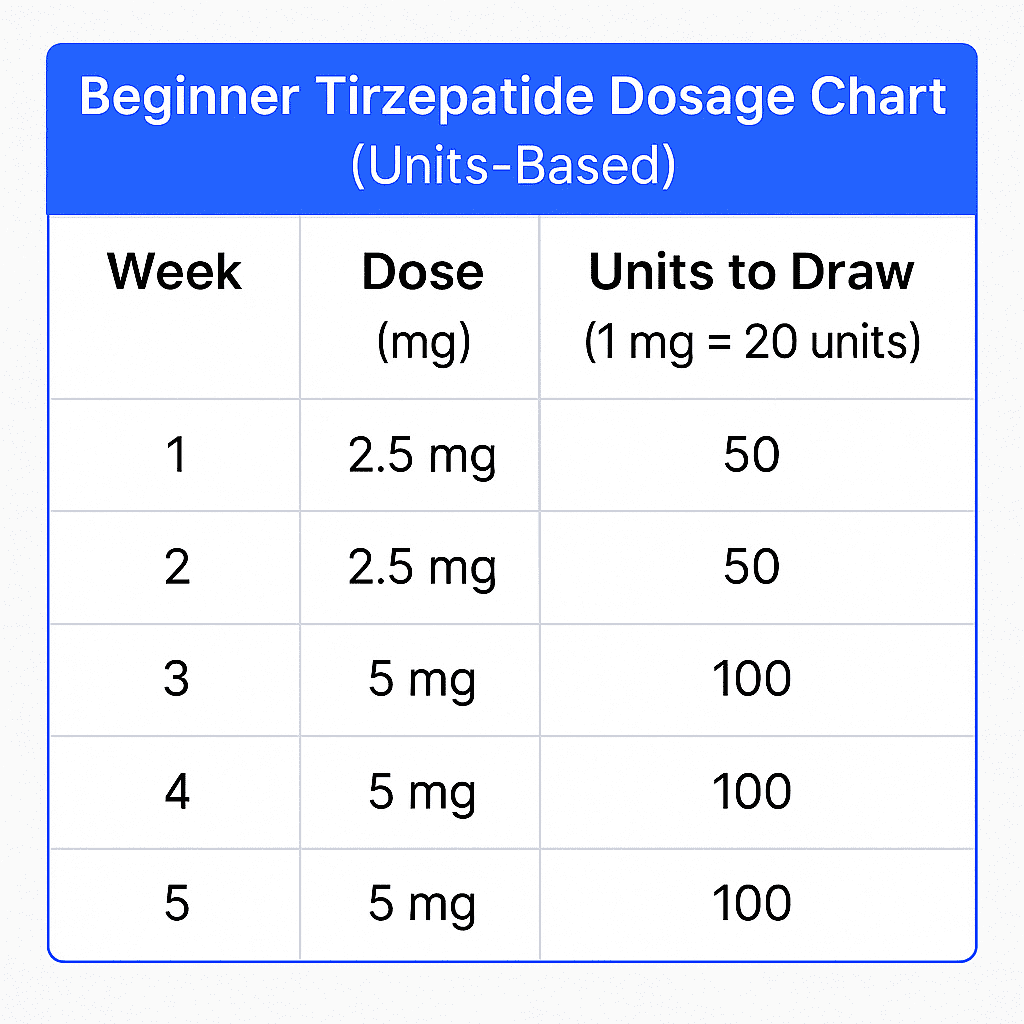
For beginners, starting at 2.5mg per week helps minimize side effects like nausea or stomach discomfort. After two weeks, many users move to 5mg depending on tolerance.
Advanced Tirzepatide Dosage Chart (Units-Based)
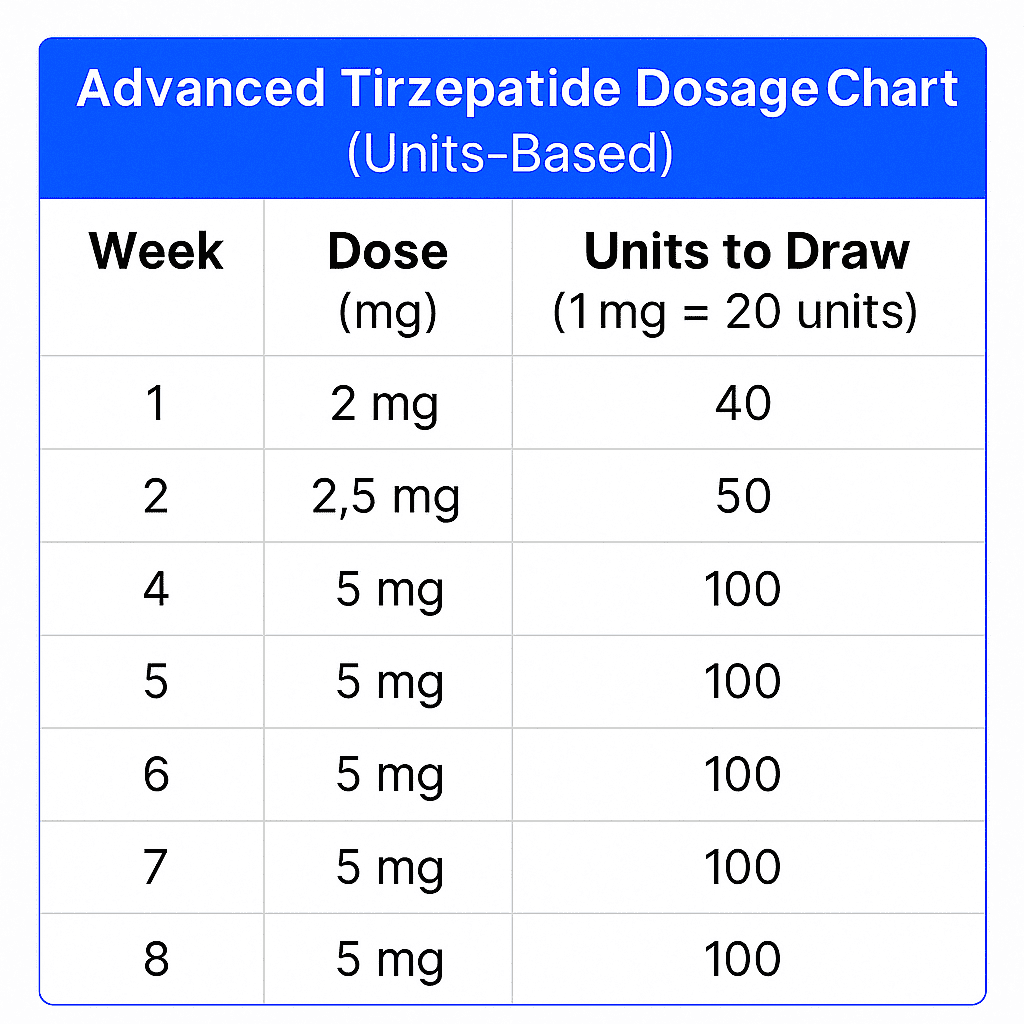
Advanced users looking for enhanced weight loss and metabolic benefits may increase their dose up to 10mg, as long as it’s well-tolerated. The number of units drawn increases accordingly—so accurate measuring is vital.
Tips for Dosing in Units:
Use the same brand and size of insulin syringe each week for consistency.
Mark your dose on the syringe barrel or dosing tracker.
Stick to one reconstitution method per vial to avoid confusion in unit-to-mg ratios.
With this unit-based dosage chart, both new and experienced users can confidently follow a schedule tailored to their goals, all while ensuring they stay within proper tirzepatide compound dosage in units.
How to Measure and Inject Accurately
When working with tirzepatide dosage in units, precision is everything. Most users rely on U-100 insulin syringes, which are marked from 0 to 100 units. These markings help translate your dosage into clear, visual increments, especially when using a 1 ml syringe.
For example, if your tirzepatide peptide has been reconstituted at 10mg per 1ml, that means 1mg equals 10 units. So, to draw 5mg, you would fill the syringe up to the 50-unit mark. To draw 2.5mg, you’d fill to the 25-unit line.
To reduce the risk of measurement errors, follow these tips:
Always use a fresh, clearly marked U-100 insulin syringe.
Double-check your reconstitution ratio before drawing your dose.
Draw slowly to avoid bubbles and ensure an accurate volume.
Administer subcutaneously, ideally in the same general area each week (such as your abdomen).
If you’re unsure about the conversion or want to be 100% accurate, use the free Peptide Dosage Calculator from PeptidesPower.com. It allows you to input the vial strength, BAC water volume, and target dose to calculate the exact number of syringe units required.
FAQs About Tirzepatide Units and Dosing
Is 5mg of tirzepatide 50 units?
That depends on how you’ve mixed your tirzepatide. If you reconstitute a 10mg vial with 1ml of BAC water, then 1mg = 10 units, making 5mg equal to 50 units. However, if you use 2ml of BAC, 5mg would be 100 units. Always calculate based on your dilution ratio.
Can I use the same chart for compounded tirzepatide?
Yes, but with caution. While the compounded tirzepatide dosage in units may follow similar logic, purity and strength can vary slightly depending on the source. Stick with trusted, lab-tested suppliers and confirm vial concentrations before relying on any chart.
What’s the safest way to increase my dose?
Start with a low tirzepatide starting dose (e.g., 2.5mg), then gradually move to 5mg or 7.5mg as shown in the beginner and advanced unit-based dosage charts. Increase your dose no more than every 2–4 weeks, and monitor side effects closely. Always inject on the same day each week to maintain steady levels.
Final Thoughts on Unit-Based Tirzepatide Dosing
Understanding tirzepatide dosage in units is one of the most important steps toward safe, consistent use—whether you’re using the compound for weight loss, blood sugar regulation, or general metabolic support. With so many reconstitution options and vial strengths available, knowing how to convert mg into accurate insulin syringe units helps eliminate guesswork and minimizes the risk of underdosing or overdosing.
If you’re working with compounded tirzepatide dosage in units, precision is even more critical. Depending on whether you mix your vial with 1ml or 2ml of bacteriostatic water, your unit-to-milligram ratio will change. That’s why referring to a clear dosage chart or using a reliable Peptide Dosage Calculator is essential for maintaining safety and maximizing results.
Outside of unit conversion, a few practical tips go a long way. Stay hydrated daily, as many users experience appetite suppression and unintentionally reduce fluid intake. Stick to the same injection time and day each week to stabilize GLP-1 and GIP hormone activity. This helps reduce side effects and keeps your energy levels more predictable.
Don’t forget to track your progress, including hunger levels, energy, weight, and any side effects. If you notice plateaus or issues, revisit your mixing ratio, recheck your syringe measurements, or consult a dosing chart to confirm accuracy. You can find unit-based dosage visuals for both beginner and advanced cycles on PeptidesPower.com.
Whether you’re just starting or adjusting your dose, using unit-based tirzepatide dosing ensures every injection supports your health goals with precision.
